


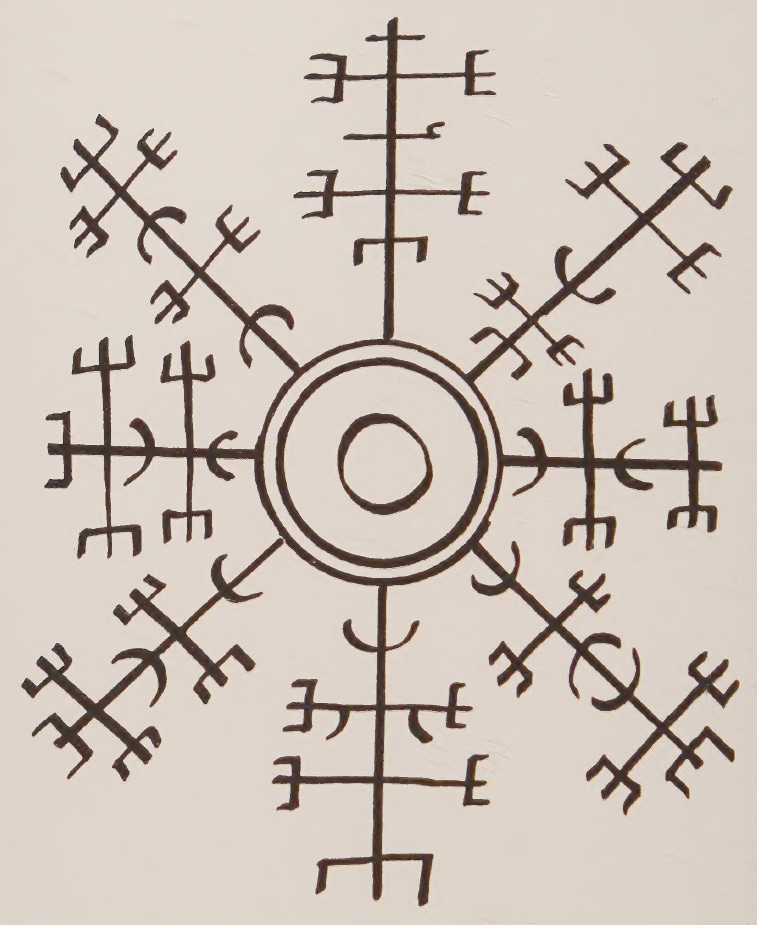
With the loss of magical practices—denounced as either unscientific or superstitious—the West also lost its “magical shield”. Indeed, our sacred space has been invaded by hordes of foreigners under the guise of equality and diversity. I argue that we need to re-enchant the Western peoples, and their lands, as the crucial step toward warding off demons.
Fun fact: Borders used to be sacred. When ancient farmers decided to convert a patch of land into productive soil, a magician or priest would first circle the land and hallow its borders. The newly created agricultural land was then considered magically separated from natural wilderness, for example, to ward off invasive insects and crop diseases.
The modern movement against such borders constitutes a wholesale spiritual attack on the sanctity of exclusionary spaces. Such spaces that we can control and own are necessary for the survival of any people.
When Catholicism came to Europe, it relegated heathen magic to the realm of Devil worship. Catholicism, notably, didn’t deny magic was real. The Church merely tried to ban unwanted magic. Witches were burned, likely because the women were heathen seeresses and considered a threat to clergical power. Then came the Protestant Reformation which erased magic altogether in favor of rational sciences.
But if magic were harmless superstition, why did Europe’s profane rulers so aggressively hunt down and exterminate magic’s practitioners? Surely, the shamans and seeresses were thought of as a real threat against worldly power, not merely a cosmetic nuisance. And I think I know why: In heathen Europe, our brand of magic was commonly tied to the spoken word, much unlike the Asiatic shamans who practiced demonic possession while in a state of trance.
European magicians tended to exert power through prophetic poetry, chants, spells, and songs. I.e., the “freedom of magic” was as dangerous to political power as “freedom of speech” is today. In a way, freedom of speech is the freedom to practice magical incantations. Though only a few gifted people know how to wield words properly, those who do would have won immense influence. Free speech, like free magic, gives financially powerless individuals the power to influence political affairs. And that’s dangerous.
By purging magic, it was the Protestant Reformation that ultimately allowed for the Industrial Age to begin. The shift away from magic to religion (under Catholicism), and then from religion to rationality (under Protestantism), paved the way for exponential technological and economic growth. We hailed the newfound wealth the way Faust welcomed the Devil. We sold our souls to economic regimentation.
Magic, today, plays no overt role in ‘advanced’ Western society. Magical practices are looked down upon as children’s fantasy. German philosopher Martin Heidegger warned of such disenchantment in favor of “thingness”. We have become mere matter, he wrote, things, gears and levers to be turned and pulled. Rather than mortals, we have become employees occupying a giant gas station called Planet Earth.
Heidegger also spoke of the de-godding or the “flight of the gods” (Entgötterung), leaving humanity behind in a godless, calculative world, i.e., the modern world of so-called technological progress. But Heidegger and others saw technology as a threat. They accused Western man in particular of dominating the planet by holding Mother Earth captive through the use of machinery. Technology was man’s victory over the Earth’s resources, but at what cost?
Technological dominance, in my view, also implies the loss of magic which next exposed ourselves to primitive attacks. We’ve lost our reproductive vigor, for example. When we hail Poland’s recent economic boom, we ignore that native Polish women are now having barely one child per woman, thus opening Poland up for mass migration. What is really the point of technological progress if it exhausts one’s race? What is the purpose of generating wealth if it means to give it up to primitive invaders?
Does technological progress distract us from living a more meaningful life?
In James Cameron’s Avatar, the primitive blue creatures, guided by their spirit goddess Eywa, turn against the technologically superior humans whose endless-growth economies have nearly destroyed their home planet. In reality, we don’t need to wait for an alien species to come and teach us such a lesson. Our technological prowess will run out of steam long before we develop interplanetary space travel.
The lesson to be learned comes from Yemen’s Houthi rebels throwing sticks and stones are hi-tech drones. Think of the modern, rich, and powerful USA that is somehow unable to stop having its founding race from being replaced with low-IQ, third-world immigrants. When our magical defenses were broken down in favor of technology, we opened ourselves up for demonic destruction as well as endless mass migration.
It seems we have traded our spiritual energy away for temporary progress. Sapped and trapped, the sacred has been nearly devoured by the profane. We’ve sold our magic (our soul) to the Devil (technology). This removal of the “sacred shield” that was meant to protect and preserve us was, in fact, the first step toward our mental, moral, and techno-masochistic decline.
The Na’vi of Avatar’s Pandora are strong because they still have their magic, whereas the humans are weak because they’ve lost theirs. And so it is in the real world here on Earth.
In his book Anglo-Saxon Magic, author G. Storms mentioned many of the sort of charms and spells that the heathen magicians of North-Western Europe once cast. Most of these spells relate to protective measures against disease or theft, and also against one’s enemies. We find a good collection of spells in the Icelandic Galdrabók (the Book of Magic). Though heavily Latinized, the spells’ intents were still heathen. By and large, the heathen Nordic-Germanic magicians acted as spiritual generals and doctors, guarding the wellbeing of their people.
So, why did the West embark on this path, to give up magic for technology? Might one regard magic as a spiritual technology and modern technology as disenchanted magic? Why did Protestantism in particular favor technology over magic?
Well, for starters, Protestantism is based on the Mosaic prophets of the Old Testament (Moses et al.), whereas Catholicism is a New Testament Christianity based on ancient Egyptian magic. In a way, Protestantism is much more “Jewish” and mercantilist than Catholicism, which drove Jews out of the Church around the third century AD. When there is talk of “Judeo-Christian values” (a literary invention of the late 19th century), we are perhaps looking at a geopolitical construct meant to help get American evangelicals behind support for Israel.
The two branches of Western Christianity (Catholic and Protestant) might as well be called different religions, for one still wields magic, and the other denies magic is real. Importantly, Protestantism became the religion of the Freemasons. Catholics and women were initially barred from joining. Masonic lodges spread across the globe along with the spread of the British Empire. And so, Protestant Freemasons became the world’s secret shadow elite.
It has led some to comment that, perhaps, Protestantism was a Judeo-mercantilist invention meant to overthrow the still magically oriented Catholicism. Under the British Empire, this mercantilist empire, many national populations were subsequently converted into consumers and, later, into expendable assets.
Remember what Heidegger said? He warned that technology would turn the whole Earth into a standing reserve, a giant gas station meant for consumption. In The Wealth of Nations (1776), Adam Smith summarized it as follows:
“To found a great empire for the sole purpose of raising up a people of customers may at first sight appear a project fit only for a nation of shopkeepers.”
Smith called Britain a nation of shopkeepers but failed to mention that the British elites, at the time, were influentially Jewish or had, at least, adopted Jewish mercantilism. It certainly weren’t the heathen Celto-Germanics who had abandoned their magical ways in favor of global consumption. An alien race had turned Britain into a shop, and would later turn America into a mall.
Malls and shops are famously open to members of all races and religions. Magical boundaries, such as those once set by the ancient priests, were now considered economic nuisances. The world was forced to open itself up to commerce and trade, to the benefit of certain global elites.
Subjects of the West ceased being purposeful mortals and became products of the technological age. No longer were we growing food to feed families, but rather, we started breeding families in order to sell more food. We started diluting food’s nutritional contents in order to sell more of it, while teaching people to “drink more water” to help them flush minerals out of their bodies, forcing people to eat more. In line with this, the Ozempic medicine, which is supposed to reduce one’s fat contents, perfectly help sell more food again.
Food has lost its magic. No longer is food a substance meant to nourish both the soul and the body. Modern food only nourishes the body, but barely, while depriving the soul. Selling more food (and clothing and houses), as you will understand, became one of the drivers behind mass migration. Once poor nutrition killed a population’s will to reproduce, mass immigration became required to continue the scheme.
We need to put a stop to this development. What we need is an overturning of modernity.
Icelandic language still betrays the importance of the magicians, who were called the “megttugaste”, or the mightiest of men. Though Iceland’s magicians were generally considered lower-class, namely financially poor, they were frequently literate. The history of Iceland’s magicians shows that magic was not reserved to the elites, who sometimes practiced it, but to anyone with the right spiritual skillset.
Throughout the pre-Christian European age, master magicians and high priests generally ranked above worldly leaders such as kings and princes, and below only the gods. The rich used to bow before their priest, and emperors needed their magician’s approval for war.
The peoples of the West need a spiritual renewal that begins with the embrace of magic. We cannot possibly defeat diversity and multiculturalism until a new generation of priests and magicians is allowed to hallow our borders and sanctify our exclusionary spaces again. We shall fight globalism not with more technology, but with magical incantations.