


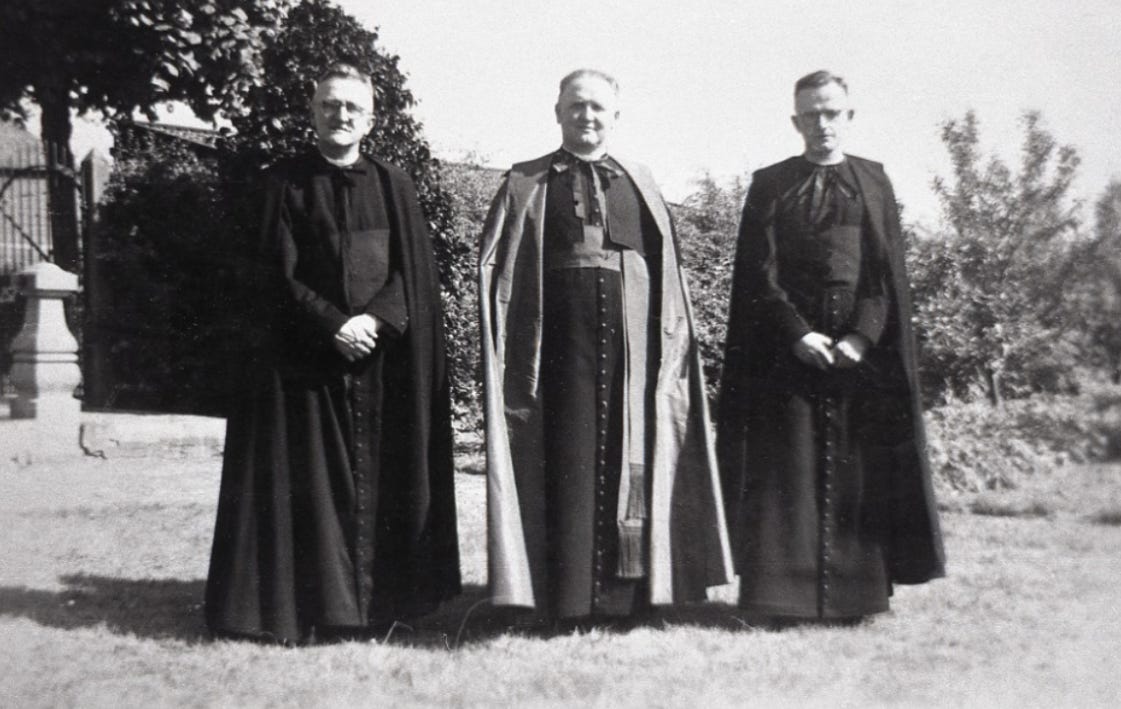
In his address held before the Roman Catholic Workers’ Association in 1932, my great-uncle Willem Koenraadt called for the abolition of “high capital” and a return to the vocational groups of the Middle Ages. Equally, he lamented “petty, small-minded state interference” and spurred workers on to direct their “eyes only still toward the future” and “to reach for deeds”. Writing in the 1930s, he was not yet aware of the immense power of American capitalism that would later consume Europe in the post-World War II period until today. But the time to implement Koenraadt’s ideas for a renewed social order is now.
Material distress is bad; but much worse still is it that in this pagan world so many souls are lost.—Willem Koenraadt
Toward a New World Order
Is there any clearer proof that the humanity of our day is chained with slave-fetters to destructive principles than the very course of the crisis that has afflicted the world in recent years?
The cries of distress from groups and peoples have grown ever more urgent and numerous; discussions and consultations, both national and international, have followed one another for some time now as if without pause. And with all that, we now stand at the edge of the abyss. “A world and a system are collapsing together,” so said the English prime minister MacDonald in his opening address to the Lausanne Conference. And why? Because the deeds that would bring relaxation and deliverance have failed to appear. People have talked, deliberated, yes, time and again, but they never arrived at effective decisions and deeds, because the principles by which the statesmen allowed themselves to be guided, the basis on which they conducted the negotiations, were not, or at any rate not on all sides, sound.
Did not Albert Thomas, the much-lamented director of the International Labor Office, still in his last great speech direct a sharp and impressive indictment against the governments for their lack of effective decisions calculated for the revival of world prosperity?
And by this admonition to deeds Thomas meant far more than the success of the conferences of Geneva and Lausanne, far more than a substantial reduction of armaments and the cancellation of the reparations debts. He certainly intended to express no less the necessity of the systematic ordering of economic life. For in the resolution adopted by the most recent international labor conference, the attention of the Council of the League of Nations and of all members of the international organization of labor and of the League of Nations is asked, among other things, for this point: “that the problems of production and trade be subjected by the governments, with the cooperation of the representatives of the most representative organizations of employers and workers, to an investigation, in order to arrive at international agreements that will make it possible to restore economic life on the basis of large common plans.” (De internationale Christelijke Vakbeweging, 1932, 74.)
Indeed, “a world and a system are collapsing together.” Certainly, reduction of armaments and cancellation of the reparations debts form an important good within the framework of the distress of these times. One can call them conditions that must necessarily be fulfilled so that reconstruction may become possible.
But debt cancellation and savings on armaments have as such only a negative effect. Hopefully an open path will thereby be cleared for the revival of the now so shaken confidence in the credit and production system, which in turn should give the impetus to the resumption, nationally and internationally, of the credit and goods traffic. But on what foundations this latter must take place, nothing further is decided by that cancellation or reduction of debts, and for lasting progress, for definitive recovery, it is precisely this that matters.
For the war and its consequences have certainly contributed considerably to the acceleration and intensification, to the acute appearance of the economic crisis of which we are now witnesses and victims, but the real cause lies much and much deeper and must be sought in the development of the system upon which social-economic life has been built up over the last hundred years.
To have set this forth clearly, profoundly, and authoritatively is certainly not the least merit of the encyclical Quadragesimo Anno, and it has very special significance for the times of distress we are now going through.
For anyone who is somewhat informed about the history that has been experienced in the social-economic field, and certainly those who have stood in the midst of the struggle, can count on their fingers that in the near future there will be no lack of stubborn, convulsive attempts to reconstruct the practice of economic life on the old foundations. And this must be prevented at all costs.
To that end it is of great importance to proclaim again and again from the housetops what Quadragesimo Anno teaches about the currently prevailing social-economic system.
Precisely now, when everyone feels it in his own body, when it is tangible with the hands, how far the present system, because of the defects that cling to it, remains removed from its goal, general popular prosperity, precisely now is the suitable time to hammer those teachings of Quadragesimo Anno into heads and hearts and thus form a powerful impetus toward the necessary changes.
The Culprit
The abuses that we now so regret in the social and economic field are by no means blamed by Quadragesimo Anno on the fact that those who perform the labor are not at the same time owners of the capital goods, of the means of production, but rather on the fact that, and on the degree to which, those who have the capital in their hands have abused their economic position of power in order to direct the whole of economic life according to their own wish and to their own advantage, without thereby having an eye for the interests of labor and for general popular prosperity.
The world had to come to those serious excesses because it—and that is the deepest cause of its aberrations—because it believed in the order-creating power of what Quadragesimo Anno calls “the pernicious individualism,” “the disastrous individualistic spirit.”
With the setting aside of man’s social destiny, with absolute disregard of the Christian moral law, the slogan was raised that the individual must be able to live himself out for social-economic life in all its tendencies and aspirations. Neither the economy, nor the social ordering, nor politics might place any obstacle in the way of that. And since the French Revolution reality has set itself to that slogan: for many years the state abstained from legal intervention; in the social structure all groupings between the state and the individuals were swept away; in economic activity man was given the possibility of listening only to what brute self-interest dictated to him. In other words, individualism received the sphere of action suited to it, which Quadragesimo Anno designates as “the unhindered competitive struggle,” “free competition.”
And when one further considers that this individualism, surrounded by that free competition, has in the course of the years passed from the individual to all kinds of combinations, especially in the production process and in banking, and also to peoples in their tendencies and mutual relations, and that these principles have now already been able to continue their disruptive work for over a hundred years, more or less, then it can no longer cause surprise that we now sit so hopelessly in the swamp with general popular prosperity.
“A proper regulation of economic life cannot be left to free competition,” says Quadragesimo Anno; “it can impossibly be a guideline for economic life” (87).1
It is good to realize this truth clearly, and therefore I consider it useful still to let the light of the encyclical fall for a moment upon the spirits that have been called forth by that individualism and that unbounded freedom of movement over social-economic life.
Christian norms, justice and neighborly love, have been abandoned; the disordered passions by which man so easily lets himself be carried away as a consequence of original sin have taken their place. Hence that insatiable greed for gain, which has indeed always driven men to violate God’s laws and to trample the rights of their fellow man, but which never so tempted human weakness as under individualism and free competition. In the service of this profit-seeking all means are considered holy. It does not even concern itself with the interests of immortal souls; for many do not ask themselves “whether their enterprise provides for appropriate needs,” and do not shrink from “shamelessly stimulating human passions (the lust for pleasure, ease, and luxury) and abusing them for their own benefit” (104) and “while inanimate matter leaves the factory ennobled, men are corrupted there and lose moral value.” (105).
With all that the economy has lost its social character and denied its essential purpose. It has ceased to be a natural cooperation and interlocking of enterprises and businesses in the service of the community, for the reasonable satisfaction of needs. It has become Privatwirtschaft, Erwerbswirtschaft, Rentabilitätswirtschaft: it is in principle a jumble of loose units, each of which “is concerned only with the question of how it can increase its wealth” (p. 104).
Of the economic struggle to which all that had to lead, the weak have become the victims. The profit economy has brought much wealth into the world, an abundance of material goods, but “is not the mere fact of those boundless hordes of proletarians beside a small circle of immensely rich people the most irrefutable proof that the riches are by no means properly distributed and have accrued to the various classes of society in a proportion that is anything but correct?” (77).
And not only that the riches have piled up with a few, but also—especially characteristic of this latest aspect of economic development—also an enormous power, a despotic economic domination has concentrated itself in the hands of a few. In the unrestricted competitive race, namely, many enterprises and banks have had to give up. Ultimately only a few gigantic enterprises and banks have remained standing, which through cartelization, trust formation, bank concentration dominate the whole of production and credit and in a dictatorial manner prescribe how much shall be produced, and at what price the goods shall be sold, under what conditions the credits shall be granted, and which enterprises shall be eligible for that credit. And in all that those power-holders allow themselves to be guided not by concern for the interests of labor, of industry, or of the general welfare, but by the profit effect.
They do not even shrink from bringing the state authority, which “free from all partiality, and concerned solely with the general welfare and justice, ought to throne high as a king and supreme arbiter” (93), under their influence and making it subordinate to their individualistic profit aims.
Let me finally mention only this: on the social order so total an economic disruption could hardly have any other repercussion than what Quadragesimo Anno indicates with the words: “the arrangement of social life is violent and thereby unstable and wavering.” Through individualism and the principle of free competition the organs that during the Middle Ages supported the social order have been swept away, but through profit-seeking and its economic consequences employers and workers moreover stand as “classes” hostilely opposite each other. Because the production factor labor has become a commodity, subject to the law of supply and demand. This has split the so-called labor market into two parties that are inclined to enmity and struggle.
Behold to what the disordered greed for gain in the sphere of individualism and of free competition has led. There is the ultimate cause of the terrible disruption that we now behold and experience in the civilized world. It has recently been said once again by the latest encyclical from the Vatican, Caritate Christi compulsi. With these words: “Has not the drive toward perishable goods been branded by the pagan poet as ‘accursed thirst for gold’; is not that base self-interest, which all too often is the sole driving force in attending to the necessities both of individuals and of the states among themselves; is not covetousness, under whatever name or under whatever form it presents itself, the principal cause by which we see with pity mankind brought to the edge of the abyss?”
Consequently, for the reconstruction of the world economy more is needed than cancellation of debts and reduction of armaments, however important and urgent this work may be.
This insight must establish itself generally and clearly in this straitened time, in the first place among those to whom the encyclical Quadragesimo Anno has been entrusted as a heritage; at the same time the consequences of this insight must be drawn with prudent but energetic perseverance.
The immediate future is a very important time for the social-economic order, nationally and internationally; it must and it shall be a time of deeds. And then we, Catholics, together with all who understand the language of sound reason, must be present, take the lead as much as possible, so that the deeds to be performed would be of such a nature that a turning point and a responsible turning point in history is made.
Advancing Unanimously
With a view to those coming and impending deeds, I consider it a gratifying fact that Quadragesimo Anno has removed the ground from the disputes of an economic and social nature that have occupied Catholics in recent years.
The exchange of ideas concerned especially the present social-economic system, designated as “capitalism,” the right of ownership, income without labor or capital interest, and labor, which according to the opinion of some was the only legitimate title for the acquisition of ownership.
It is not the intention—and it is also not possible—to enter here into these controversial questions, nor also to explain the relevant teachings of the Pope’s social encyclical.
Let me remark in general that through Quadragesimo Anno the radical views are not accepted on the points mentioned, which—in the footsteps of the well-known publicist and champion Baron von Vogelsang—have been proclaimed in that regard by the so-called Neue Wiener Richtung or New Austrian school with Eberle, Lugmayer, Horvath, Orel, Ude, Landmesser, Wiesinger as the most prominent representatives.
I consider it gratifying that through the Pope’s encyclical the ground has been removed from the said disputes.
For in the first place these controversies brought a division that was no longer limited to the scientific practitioners of social economy, but had already sunk down to the men of action. And this would in the long run have influenced our practical work very confusingly and paralyzingly; while for the near future we need nothing so much as a strong, decisive, and therefore unanimous push toward social construction and economic reform.
Added to that is the fact that these controversial questions, certainly for a large part, divert attention from what for these times is the first and principal thing.
I by no means wish to assert that problems such as the right of ownership, the legitimate titles to the acquisition of ownership, the significance of labor, capital interest, the wage for labor are in themselves less weighty questions; or that we must for the time being merely maintain the existing order of things on these points or let it take its course. No, the men of science and the social workers must also in this time of distress in due course give full attention to that piecework. But precisely because this is piecework, because it does not directly concern society as a whole, but only private interests, interests of groups and individuals, therefore that work may not stand in the foreground for this time. The world is now in birth pangs; a new social order is expected; to the acceleration and the good outcome of that birth we must all devote our first and best forces for the near future. The more so because the teachings of Quadragesimo Anno on the right of ownership, the wage for labor, deliverance from the proletariat through a fairer distribution of earthly goods can never be carried through better and more completely than within the framework of the restored social order.
To this last theme, then, everyone’s attention, both theoretical and practical, must be given in the first place in this time.
The papal encyclical itself judges no differently about it. For after the teachings on the said points of controversy have been given, the encyclical introduces its expositions on the restoration of the social order with these words: “What we have so far set forth about a fair distribution of earthly goods and about just wages relates to individuals and only indirectly touches the social order. But precisely on the restoration of that order according to the principles of a sound philosophy and on its perfecting according to the lofty teaching of the Gospel was all the thinking and doing of our predecessor Leo XIII directed” (p. 83).
On this principal doctrine, the core theme of Quadragesimo Anno, I must now let a few thoughts pass.
Toward Social Restoration
It is known what the encyclical means by “the restoration of the social order.”
Two things belong to it: something that relates to the external form, to the structure, the embodiment; and something that bears on the spirit, the inspiration.
Concerning the form, the encyclical desires that the organic idea of the Middle Ages shall revive: between the state and the individuals vocational groups must be established for the regulation of social and economic life, and that on the basis of public law.
The spirit that must make these organs answer to their purpose, that must be the soul of the relations between the members of one and the same organ and of the relations between the organs among themselves and to the whole, can be no other than the spirit of Christianity, more particularly of social justice and of social love.
The reform of institutions and the improvement of morals together form the restoring social order. They are not to be separated from each other. Already in the encyclical Rerum Novarum they stood together: “If society seeks healing,” writes Leo XIII, “it can find it only in the return to Christian life and Christian institutions.” (p. 27).2
The renewal of morals is a means to make the institutions succeed in their design; without the firm foundation of Christian morals they are “a building that is built on loose sand,” they are just as damnable and just as doomed to failure as the individualism and free competition of present society.
But the reverse is also true: because man has a social nature, is insufficient as an individual, can achieve the full development of his personality only in and through society, for that reason the reform of institutions must be used as a means to be able to arrive at the improvement of social morals.
Form and spirit are consequently dependent on each other, must obtain their realization together.
There can then also be no single tenable reason advanced for still waiting with the introduction of the new social organs. On the contrary, precisely because we have with individualism in free competition and the disordered profit-seeking finally arrived at the edge of the abyss, the reform of institutions is nationally undeniably the most urgent point of social policy.
This assertion can be underlined with the own words of Quadragesimo Anno, thus: “the principal aim, the principal endeavor of the state and of all influential citizens must be directed thereto to bring the struggle of the ‘classes’ to an end, and to call into life and promote a harmonious cooperation of ‘vocational groups.’” (p. 84).
Unnatural State Interference
That does not mean that we must stop the so-called small work in the field of social legislation. Especially under the precarious, untenable economic conditions of the present the threatened social groups rightly call for the intervention of the state, because the state is the only community organ that can still bring relief in the distress, or at least can try.
But when now that intensive, I would like to say petty, small-minded state interference, such as Europe presently displays, when that state interference is once taken out of the connection of this time and considered by itself, must it not be admitted that we find ourselves with social and economic policy on foolish and impossible paths?
It has happened several times recently that hard words, dissatisfied utterances have been directed at the address of the government: its measures came too late, or were not decisive, effective enough, etc. But have those persons ever thought that such state intervention, considering the natural course of things, actually lies far outside the limits of its capacity and of its competence? The state must fall short in attending in that manner to such affairs, because by nature it is not suited to that work and is not called to it.
History repeats itself: we have with social and economic policy come into mercantilistic waters. Only in the connection of the historically developed and of this exceptional time can and must that be justified. The sooner, however, this unnatural development can be broken with, the better. Only “the reform of institutions” can offer a way out here. We must as soon as possible return to the practice of this principle from social philosophy: The state exists to supplement the capacity of its subjects, not to displace them from the activity to which they are capable either individually or in smaller groupings.
On this “unshakable” principle Quadragesimo Anno also appeals, when it censures the development that state care has taken with these words:
The social life developed in all kinds of groupings… (has been) destroyed… almost exclusively individuals and the state have remained, to no slight disadvantage of the state itself, which… (now) had to take upon itself all the burdens that were formerly borne by those groupings that had gone to ruin, with the result that the state is overwhelmed and overloaded by an almost endless series of affairs and concerns… The state authority must leave the affairs of lesser importance, which would moreover take it up too much, to bodies of lower rank; then it will also be able more freely, more vigorously, and with more success to attend to all those affairs for which only the state authority is competent. (83/84).
High Capitalism
Our time presses for new social organs. The encyclical Quadragesimo Anno expresses itself in particularly cutting words about the characteristic phenomena of high capitalism: the joint-stock company system, the trust and cartel formations, and other forms of concentration: “A despotic economic domination has concentrated itself in the hands of a few, …, they regulate as it were the blood circulation of the whole economic organism, and have so to speak the economic life so much in their power that against their will no one can even breathe.” Under the influence of these power formations “the whole economic life has, in an abominable manner, become hard, merciless, and cruel.” (92/93).
This indeed sharp indictment may not be regarded as a rejection of the joint-stock company system, or of industrial and bank concentration as such; it directs itself against the spirit that characterizes this movement and against the manner in which that movement has actually developed.
Indeed, it is generally known that with these power formations ultimately nothing else presides than the making of profit, as was already noted earlier, and that one often shrinks from no means in order to establish, maintain, and expand those positions of power. What has become known recently around the Sklarek brothers and around Kreuger & Toll has been only a confirmation of this…
To the restoration now of the social order also belongs the breaking of this economic dictatorship; yes, even that belongs to it particularly, because that dictatorship now has the most leading position over economic life.
It is then also precisely there, where Quadragesimo Anno works out the restoration of the social order, that one finds in the encyclical these apt sentences: Much less still than to free competition can the regulation of economic life be entrusted “to the economic dictatorship…. for it is brute and blind force, which, in order to be able to work salutarily for mankind, must be powerfully curbed and wisely guided; but to curb and guide itself, thereto it is not capable. To master this dictatorship powerfully and completely, higher and nobler powers are required: namely social justice and social love,” (p. 87).
And I have already noted earlier that the Christian spirit as a means to establish itself must handle “the reform of institutions,” the public-law vocational groups.
Consequently also in order to break the economic dictatorship, our time urgently asks for new social organs. Actually those organs ought already to be established now, in order to be able to fulfill a role of significance in the future reconstruction.
The economic crisis will not end without having housecleaned thoroughly among the institutions by which the economic dictatorship is borne. Already a great deal of value has been destroyed, a great deal of expansionist urge has been clipped. It must not be possible in the future that those power formations revive in their former strength and extent, or are continued. Such giant combinations simply exceed the limits of limited human capacity. There is no single human mind, genius enough to oversee, control, master such formations, and thus no one is capable of bearing the responsibility for those creations, quite apart still from the fact amply proven by experience that the weak human will is not permanently equal to the gold-thirsty temptation in which it continually finds itself through that position of power.
The business system must consequently be simplified; bounds must be set to capitalization.
Here again salvation is to be expected only from the reform of institutions, the public-law vocational organization, built up nationally and completed by international agreements. Certainly, it is no small matter that is projected here in a few words. But precisely because there is so enormously much and grand work to be done, it is high time that the first step is finally taken.
There is consequently more than one urgent reason to await with impatience the taking under consideration of the bill on industry councils of Minister Verschuur. That a repetition of the tenancy-law history will occur thereby is, after all that has been made of it in the party council and in the Catholic press, hardly to be feared anymore. Hopefully also the institution, once it has become reality, will develop prosperously; for within the framework of the public-law vocational organization as Quadragesimo Anno intends it, the Verschuur bill makes no more than a very modest beginning. In my opinion for the near future the principal field of activity lies here, that is to say in the establishment of the industry councils-Verschuur and in their development toward full public-law vocational organization, also and especially for the Roman Catholic Workers’ Union in the Netherlands.
The Struggle of the Classes
The Union will thereby especially also have to direct its eyes toward its own circle.
In Quadragesimo Anno namely in very emphatic and forceful wording a certain disposition is rejected as being a stumbling block for the coming into being of the new social organs. “The principal aim, the principal endeavor of the state and all influential citizens must be directed thereto to bring the struggle of the ‘classes’ to an end and to call into life a harmonious cooperation of ‘vocational groups.’” (p. 84). And after having pointed out that employers and employees stand opposite each other on the labor market as hostile powers, the encyclical continues: “That this terrible evil, which drags the whole of society toward the abyss, must be removed without delay, is clear to everyone,” (p. 85).
The organized workers have in the past often had to conquer their rights through struggle and bitter struggle. It goes without saying that this method of struggle has not remained without influence on the mental attitude of the mutually contending classes. From frequent struggling a struggle mentality must necessarily arise, a bitter mood must come forth, the view take root that the workers can obtain their rights only by fighting for them.
It is clear that the groups, as such, are not very suitable for the building up of the social organism.
More still than in the past the social groups will therefore in the future have to be wary of the method of struggle. Only in the case of “extreme necessity” will one still be permitted to have recourse to the struggle, in order not to harm the disposition that must bring employers and workers together into the vocational groups.
It is so natural that someone who wants to realize a goal keeps in mind what he has had to do in the past in order to achieve similar goals.
And yet, we must in this forget the past, direct our eyes only still toward the future, toward the great goal, the public-law vocational organization, toward which from now on our best forces must be directed.
The strengthening of the good mental attitude, the ever further crumbling of the method of struggle will at the same time find benefit in these thoughts from Quadragesimo Anno:
First: it is a gross lie to assert that employers and workers of one and the same vocational group have conflicting interests: they possess common interests, for they work together in the same enterprise, at the production of one and the same product, and they must both live from the yield of that product: they are thus dependent on each other and both interested in the flourishing of the enterprise.
Next: employers and workers of all enterprises are both equally and in the same manner debtors of the general welfare and they must discharge this debt by working together harmoniously for general popular prosperity.
Finally there is still the great law of love, which makes one forget and forgive the wrong suffered, which sees all men as members of one large family and children of the same Heavenly Father; which awakens the awareness that all are one body in Christ and members in relation to one another, so that when one member suffers, all members suffer with it. (pp. 85 and 107).
Deeds
What an invaluable benefit it is that God has given us through the Holy Church in this precarious and confused time the encyclical Quadragesimo Anno. We now know what we must will; we know the path that we must go. We, Catholics, can advance unanimously and we must also do that in energetic vigor. Precisely because we know so well and so certainly what must happen in order to make the disrupted world socially-economically healthy, precisely for that reason we are obliged to take the lead here as much as possible and in strong unanimity to push toward deeds. The times are too serious for us to lose ourselves in theoretical disputes or lengthy consultations and reflections. Deeds and again deeds!
And this all the more, because the present world threatens not only to collapse socially-economically, but has also degenerated religiously-morally in so crying a manner.
Material distress is bad; but much worse still is it that in this pagan world so many souls are lost.
Meanwhile, if we want to preserve the working people religiously-morally and lead them back, if we want to bind them more firmly to the Catholic Church, then we may certainly also not neglect to be socially-economically active and to reach for deeds.
There has in recent years broken loose among the younger people from all ranks of our Catholic people such a splendid enthusiasm for the cause of Christ. Let us, who appreciate and encourage this enthusiasm but can no longer join in their ranks, let us with stubborn persistence keep pressing toward social-economic deeds, in the conviction that this work also indirectly serves the preservation and the salvation of souls.
Thus both, older and younger, are and remain through our working and striving: apostles of Christ Jesus.
HOEVEN, PROF. DR. W. KOENRAADT
The numbers in the text indicate the relevant page of the translation, which is the R.C. Workers’ Association of the Enc. Rerum Novarum and Quadragesimo Anno.
In our translation, it reads: “the Christian life and Christian doctrine!” This should be: “the Christian life and Christian institutions.” (R.K.W.V. Board)