


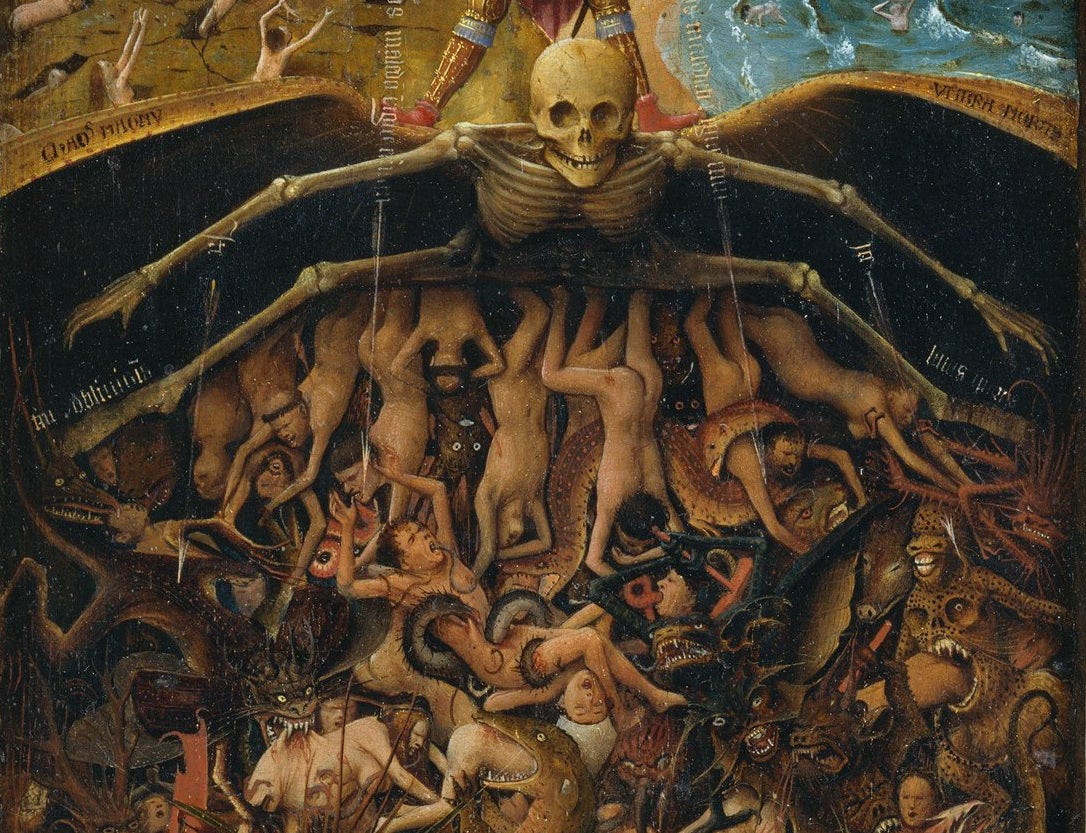
Catholic primary school taught me about the Dark Ages, but little did I know that our Dutch Calvinist curriculum was peddling anti-Catholic propaganda. Did Europe really fall under the “night of superstition” during the 5th through 15th centuries AD until the Protestant Reformation came and paved the way for the Enlightenment?
Not every country teaches kids about any Dark Ages. Italians call it La Decadenza, and it refers to the decadence of the late-stage Roman Empire before the fall. But the image of Europeans groveling like animals in a hellish darkness cast upon the earth by a Satanic papacy—well, that’s Protestant propaganda. It never happened.
According to the Google Ngram Viewer, occurrences of the phrase “Dark Ages” didn’t become popular until around the mid-18th century, and its popularity dropped starkly after the 1830s. From 1740–1780 AD, the British evangelical Methodists established themselves and began exporting their new brand of Christian faith to the USA as well. Indeed, it was this evangelical movement that first popularized the idea of the European “Dark Ages.”
The evangelicals juxtaposed these Dark Ages with the “light” of the Reformation. They spoke frequently of “popish darkness.” This makes perfect sense geopolitically, for the Anglo colonization of the Americas gave Protestants (the Atlantic nations of Britain and the USA) the power to push back against the Catholic Holy Roman Empire.
Talk of the Dark Ages dissipated after the 1830s—because that’s when the last Holy Roman Emperor, Francis II, died, after having abdicated in 1806. With the emperor gone and without a continuation, Catholic power diminished, and Europe was blinded by the Reformation’s light.
In a livestream episode (The Great Johannes stream #64), I explored at length the unintended consequences of the Reformation. According to author Brad S. Gregory in The Unintended Reformation, religious fragmentation turned our societies into the woke dystopia. Individualism, consumerism, moral and cultural relativism, the excesses of capitalism, pluralism, diversity and tolerance, and scientific atheism all emerged as consequences of the Protestant Reformation.

The Protestant propaganda stuck because Europeans, having a guilt-based morality, need to have something to feel bad about in order to feel good. We need to paint the past as backward so that we may cast the present as having progressed toward something better. If the past hadn’t been exactly dark and gloomy, then we can’t really claim to be progressing. And so, Catholicism was now evil and the Enlightenment’s science was now good.
Dig deeper and you’ll find that these Dark Ages never happened. Enter the Phantom Time Hypothesis by German author Heribert Illig. He claims that about three centuries (297 years to be exact) were inserted into the Western timeline—namely the height of the “Dark Ages” from 614–911 AD—for political reasons: to place the reign of Holy Roman Emperor Otto III in the year 1000 AD.
That year, Otto III, supported by Pope Sylvester II, made a pilgrimage from Rome to Aachen (Charlemagne’s alleged birthplace). The idea was to revive the Catholic Christian “Holy Roman Empire,” i.e., to sell it to a larger audience. The Pope, the Emperor, and their intellectual henchmen were able to pull off this time heist because the people of Europe were largely illiterate and mostly didn’t know what year it was.
Archaeology backs it up: We find few to no artifacts from the alleged Dark Ages. Illig points out that we also found almost no corpses from that period. Another pointer is that there is no discontinuity in German poetry from the 6th to the 10th century AD, as though there was no stylistic break.
In conclusion, the Dark Ages weren’t dark—the Dark Ages never happened. The phrase “Dark Ages” says more about Protestant Enlightenment propaganda than it does about history. It served to help transfer religious power away from Catholic Europe to the new Protestant transatlantic realm.
And that process is something The Reaction intends to reverse. With the decline of globalism, the Anglo-American Empire is expected to wane, and with it, the ideals of the Enlightenment (individualism, materialism, robots, AI) shall disappear.
The light from the shadow shall renew Europe’s soul!
Join the Reaction!