
The nationalists of the 19th century believed the Battle had taken place near Detmold, Germany, where they erected their memorial, the Hermanndenkmal. ‘Hermann’ is the modern German name for Arminius, the Cherusker tribe chieftain who united several Germanic tribes against Rome.
But the Detmold claim was controversial, as was the statue itself, showing the hero Arminius dressed in Roman battle skirt and carrying a Roman short-sword. It would have been more ‘Germanic’ to depict him with a spear and wearing trousers, and without the fantasy winged helmet.
Later, a dig near Kalkriese, north of Osnabrück, unearthed evidence of a large battle between Germans and Romans, but although this area now hosts the Varian Disaster’s museum, it was likely the place of another conflict, namely the Battle of the Angrivarian Wall, as evidence by an actual wall dug up there.
Is there no source left, then, that can inform us about the Teutoburg Battle’s actual location? Yes, the Icelandic monk Nikulás Bergsson went on a pilgrimage from Iceland to Rome during the mid-12th century, and he was still able to pinpoint the site.
He wrote in his diary,
“Two days till Paderborn, ... and then four to Mainz. Between these places is a town named Kiliandur, and that’s where the Gnitaheide is, where Siegfried slayed the dragon Fafnir.”
His account had already mythologized the Roman legionnaire columns into a dragon. The word ‘gnita’ means broken or sharded in Old Norse languages, and heide is a heath- or moorland. And, lo and behold, south of the city of Paderborn, we find the region’s largest limestone deposits. When farmers plow such land, they break up the limestone and create the appearance of a “broken or sharded land”.


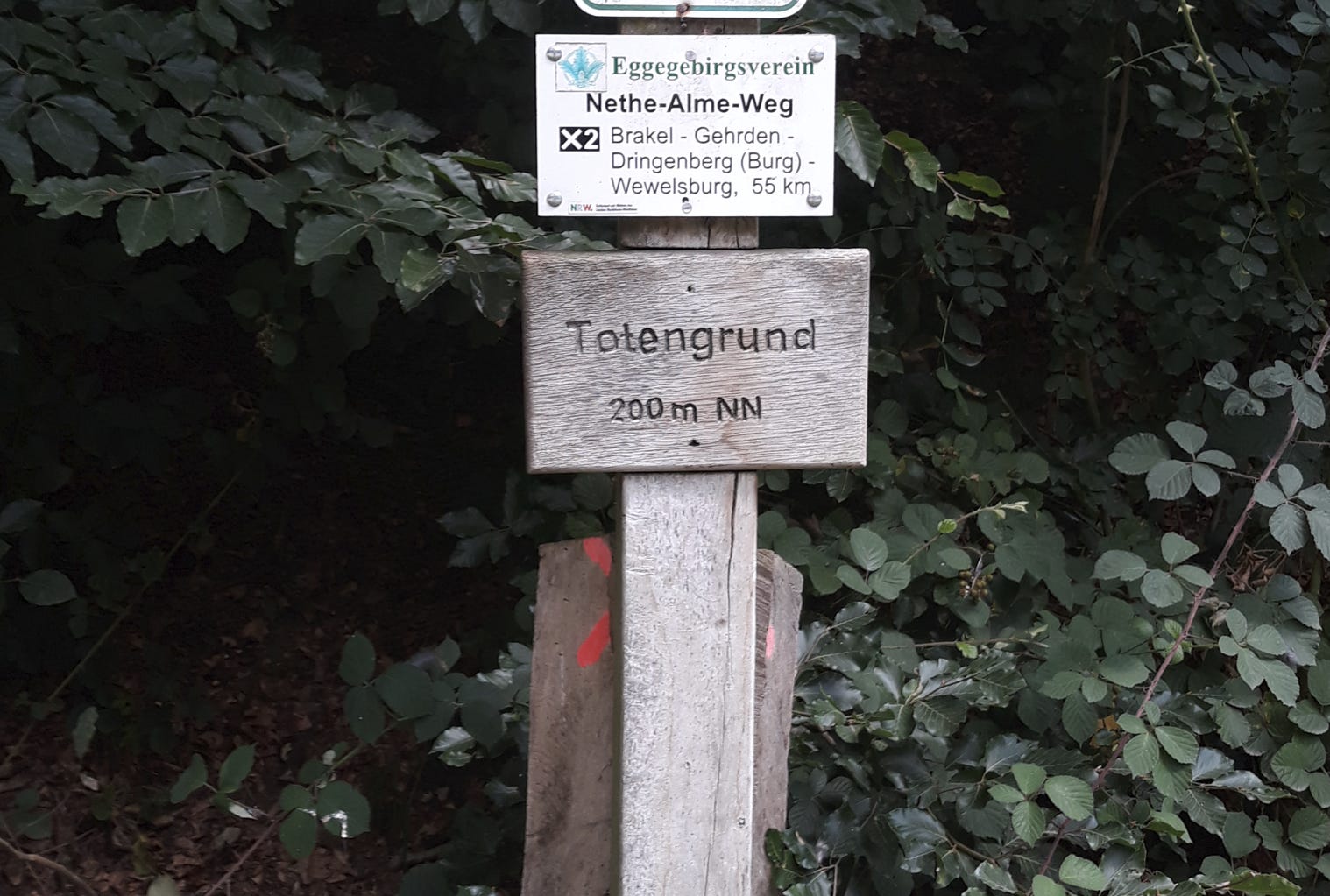
And there, we find a site named Totengrund, or Deathground, and we find the Totengrundstraße and the Taubengrundstraße, or the Death ground’s street and the Deaf man’s ground street, signaling a deadly event must have once taken place here.
The Germans, coming from the West, had the high ground here, as the Romans were following along a small stream. The Germans fought the Romans hand to hand, in close combat. That way, the Romans couldn’t make use of their superior formations. There was no room for manoeuvring in these dense forests.
So, the physically superior Germnanic individuals butchered the Romans.
Source: Martin Hülsemann, Alisonensis.


